


I sat in my Uber on Christmas Eve, staring out at the Azerbaijani countryside and watched as it morphed quickly from rural to suburban to urban during my 40 minute ride from the airport to my hotel. When I landed in Baku Airport I found the facility to be small but extremely modern, clean, and welcoming. After struggling to get my visa approved before arrival, I coasted through immigration without even being stopped to check formalities like a covid test. I quickly found myself sitting on the airport curb where my only challenge was waiting for my phone to find its connection to the internet so that I could request my ride.
As we drove I was struck by what would prove to be a theme in Baku. On the one hand, I saw opulence, the likes of which I had never seen before outside of Dubai. There were more than a few six-digit cars and we passed many unique collectibles like Ferraris and Lamborghinis. But those cars drove next to other models that stopped being produced 20 years ago and clearly had as many miles on the odometer as the high-end vehicles had dollars in value. These run-down rusty beaters were everywhere. And there were few models in between. Azerbaijan was a split society, I saw quickly, with a fancy upper class for those who could afford to show off and participate, but a struggling lower class living among this gaudy facade.
I was in Baku for Christmas not for any specific reason but merely because that’s where the trip schedule happened to place me on that particular day. Azerbaijan, like all former Soviet countries, has freedom of religion enshrined into its constitution, and it is the most secular Islamic country in the Middle East. But with that said, it is still a majority Islamic country, with upwards of 90% of residents considering themselves some flavor of Muslim. For that reason, Christmas was acknowledged here, but not necessarily celebrated.
These were the backdrops with which I began exploring Baku immediately after dropping my bags at the hotel.
Baku’s Good Side
I stayed at the JW Marriott, which was near one end of the lively Caspian shore where most of the new architecture was being built and the center of the area where Baku was working hard to reinvent itself in the vein of Dubai. Architecture was one of the primary reasons I wanted to visit this city. Stepping outside my hotel, the first building I saw was the under-construction Crescent Moon Bay, a building shaped like a moon because…why not.

I was excited!
I walked past the crescent using a tunnel that took me under a busy boulevard. I’ve seen similar tunnels in other places, and they make a lot of sense for helping pedestrians safely cross the street and keeping cars moving smoothly above. But in Tbilisi, for example, they were dirty, filled with graffiti and littered with cigarette butts. In Baku, the tunnel was pristine, tiled, and void of hawker stalls.

I began walking along a very pleasant pedestrian boulevard. To my right was the bustling city of Baku, including Baku’s version of Lake Shore Drive; that is, a large busy road with 6-8 lanes of traffic…nearly a highway, but littered with stop lights every quarter mile. Beyond the Boulevard laid the city of Baku with its numerous points of interest poking up on the horizon. To my right was the Caspian Sea, a seemingly never-ending body of water dotted with large ships and oil tankers on the horizon.
The air was warm and pleasant. As I walked along and observed, I put in my headphones and turned on This American Life, which was airing a special Christmas episode. I listened to the stories of Macy’s elves back in the United States while I explored the Middle East on this particular Christmas holiday.
Eventually I reached a mall, which seemed to be shaped like a massive glass bullet, facing upwards. It was placed right in the middle of the pedestrian boulevard, giving both walkers and cars on the nearby vehicular Boulevard easy access. I decided to peek inside. What I saw inside was a bustling Western mall on one of the busiest shopping days of the year. I took a moment to enjoy the glowing Christmas tree in its center court, then continued on my way.
As I continued my walk, I came upon more stunning buildings. One of Azerbaijan’s most significant exports is carpets (i.e. rugs) and they have a museum dedicated to the industry; naturally, it’s shaped like a rolled up rug. Another, even grander, mall is shaped like a giant star and has a massive slide inside. And the “Flame Towers” are shaped like flames and have dancing flames projected on them at night.


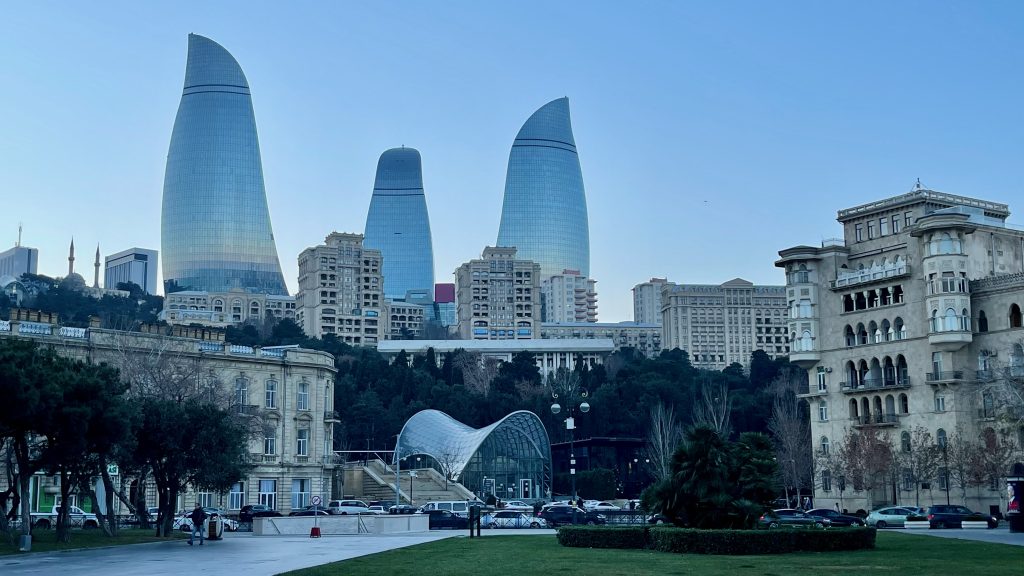
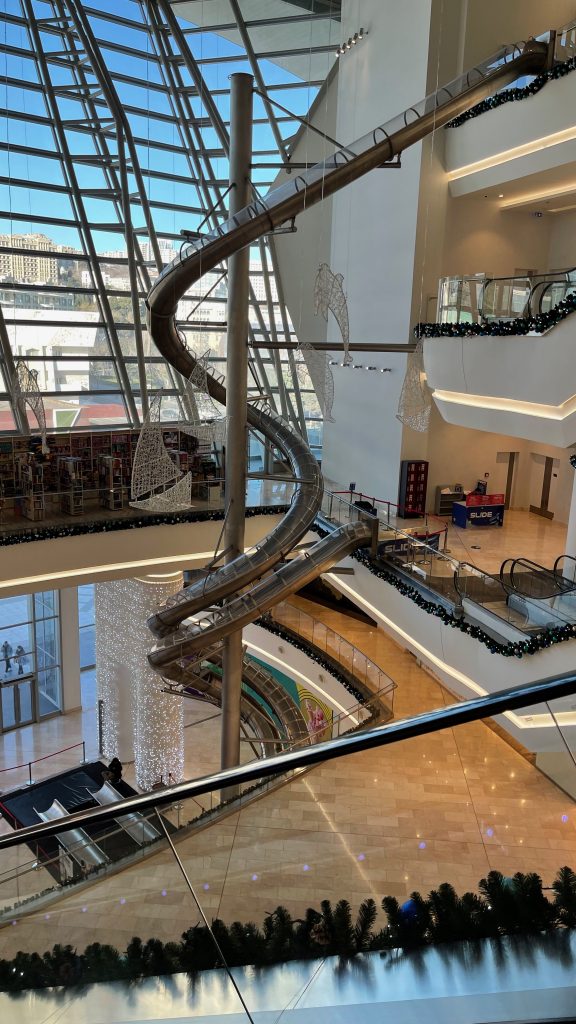
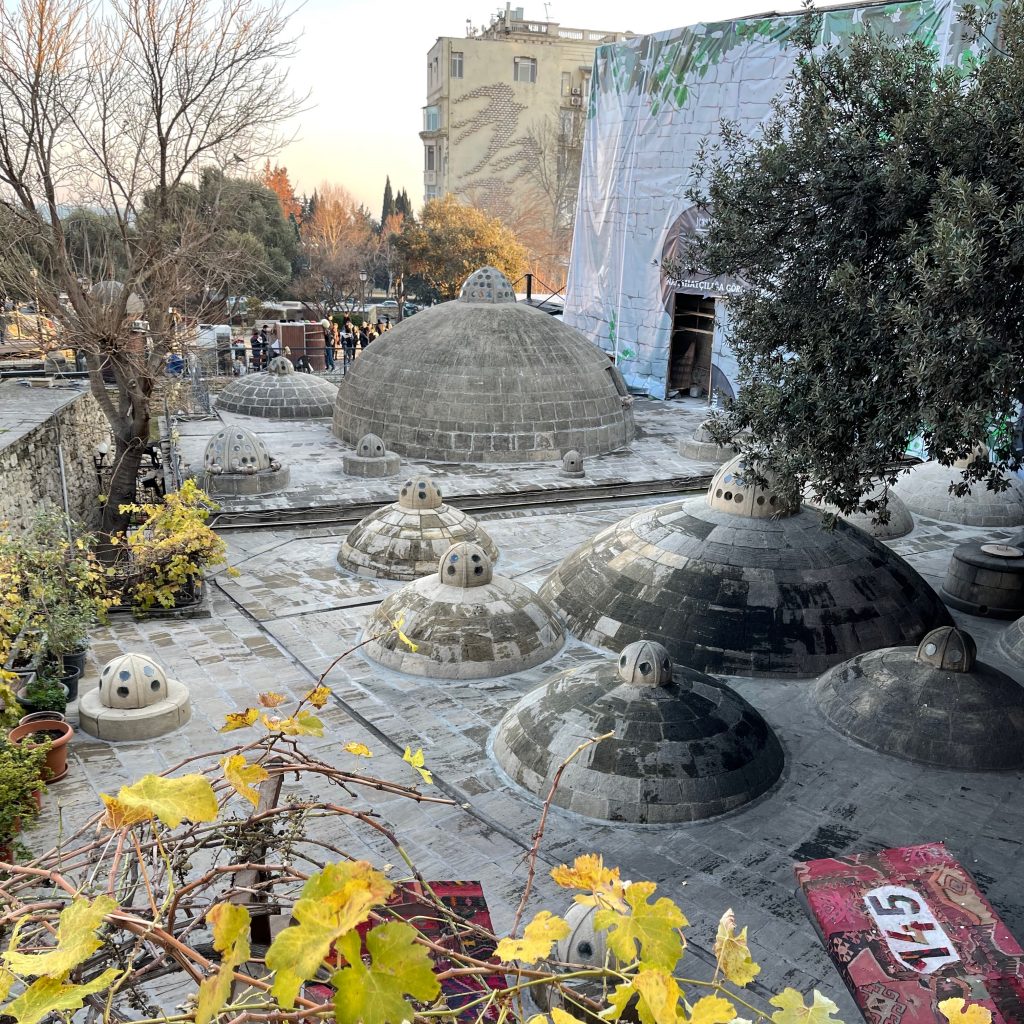
I wanted to get closer to the Flame Towers and I elected to cross the street and wander into inner city Baku. I passed a war memorial, a Christmas celebration, and numerous examples of interesting architecture. And then I came upon this seemingly ancient building, which was extremely out of place:

I found an entrance that was open and wandered into Baku’s Old Town district. This area was built hundreds and thousands of years ago when Baku was first colonized, as a key stop along the Silk Road. This district is the area that remains today. It has an entirely different vibe from the otherwise-ultra-modern city and is filled with narrow and winding passageways. Cars trundle up and down brick roads, making seemingly impossible turns in tight quarters. Delivery men ferry food on bicycles to tourists staying in buildings that have been converted to chic boutique hotels. Restaurants and bars beckon from some roads, while others are eerily deserted.
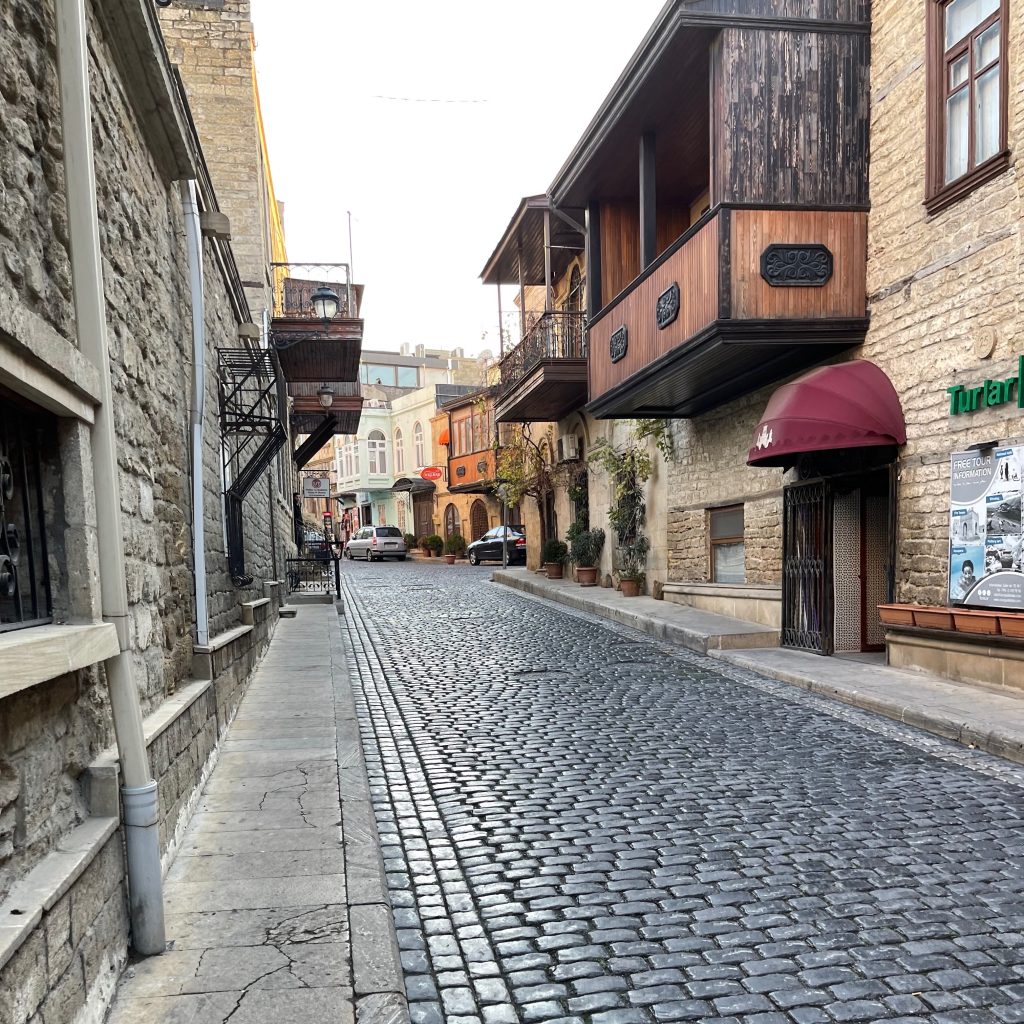
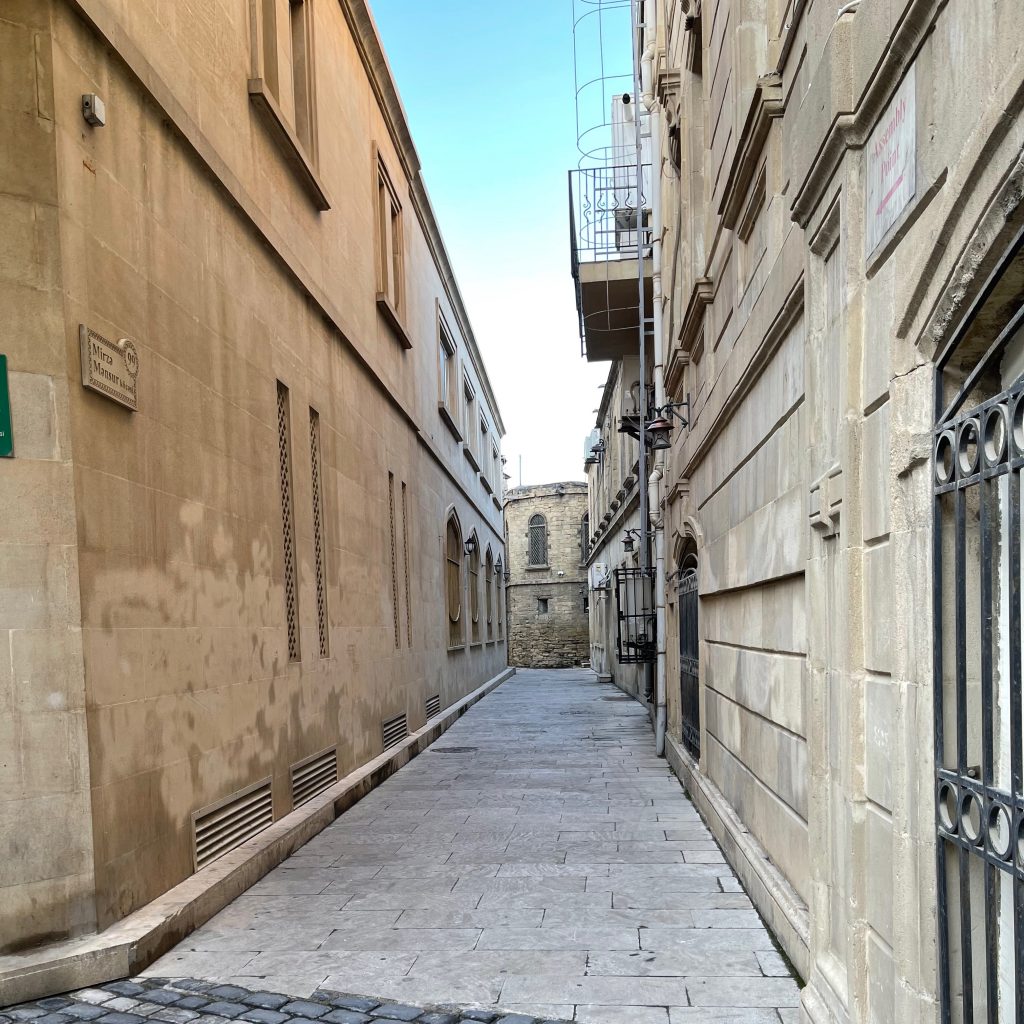

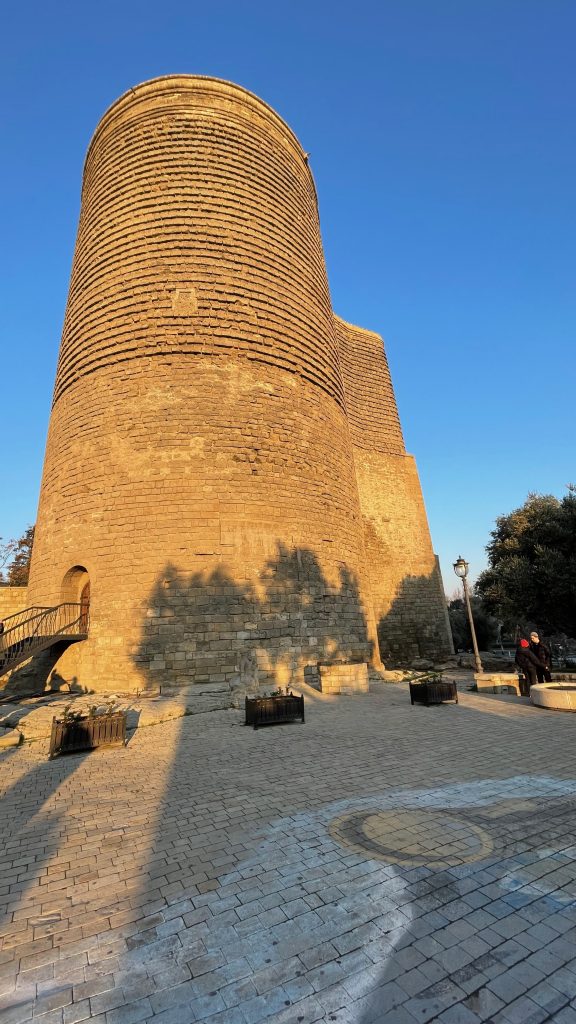
The primary attraction of Old Town was Maiden Tower, a large tower that walls walls several feet thick. This is a UNESCO World Heritage Site that today houses a museum. No one is exactly sure when it was built or why, but theories include an early temple (it has been dated to prior to Islam’s arrival in the area) and an astronomical observatory.
Baku’s Bad Side
As I left the Old Town Walled City, I headed back to my hotel to enjoy a Christmas dinner and fall asleep. I only had a single night in Baku, and my goal for the next day was to explore the parts of the city that I hadn’t yet had the time to experience.
Kicking off my day, I descended to a nearby metro station and was astounded to see a miniature art museum underground.

Once I made it to the terminal, however, I was far less impressed. Baku holds the record for the only metro system anywhere in the world thus far in my travels that I haven’t been able to figure out how to board. The attendant pointed me to automated machines and I used Google Translate to try and push the right buttons because the language kept resetting on each screen even after selecting English. I was never able to get a ticket from these machines. I ended up calling an Uber instead.
I continued my adventure by wandering around downtown Baku, nearby where I had left off the previous evening. As I wandered further from the seashore, I found a less manicured city. I still saw some nice-looking buildings, but I saw other more slum like facilities as well. These were frequently adjacent to each other.
One particularly typical street I walked down had suburban-like buildings with exceptionally nice commercial space on the bottom floor and grungy apartments above.

After wandering for several hours, I found that I needed to use the bathroom. I was thrilled to see a roadside public restroom, which seemed almost expected in a city that puts marble in their metro stations. When I entered, however, I was disgusted. This bathroom was not intended for tourists.
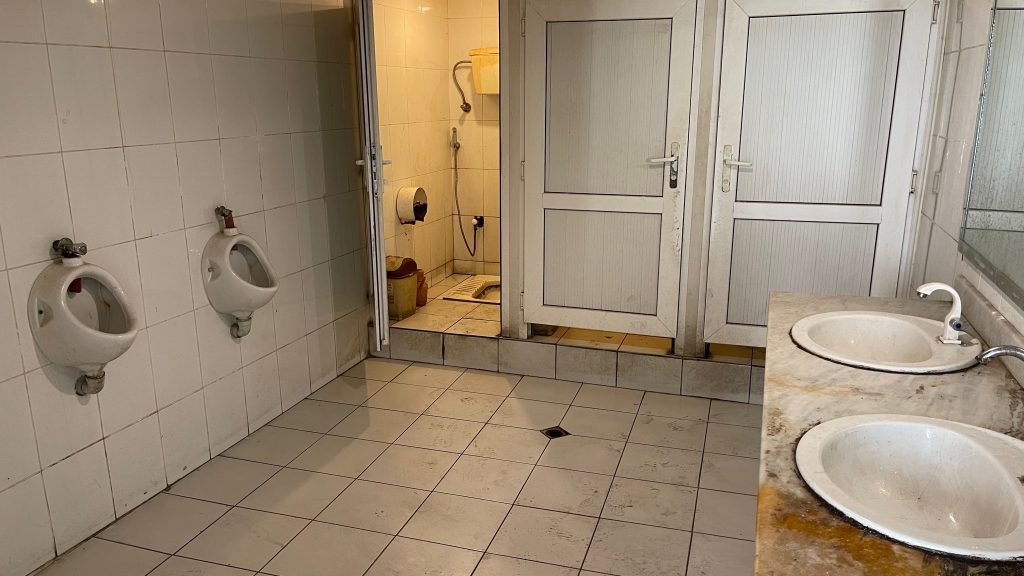
Around this bathroom were homeless encampments and destitute neighborhoods. It felt oddly disgusting to me that the city would prioritize its funds in the way it clearly had. All cities struggle with challenges like these, but most don’t simultaneously show off so ostentatiously to foreigners in one part of the city while having such a significant quality-of-life problem just a couple miles away in another. After seeing this side of Baku, I somehow felt uncomfortable continuing the architecture tour in the ritzier part of town. The experience felt somehow jaded now.
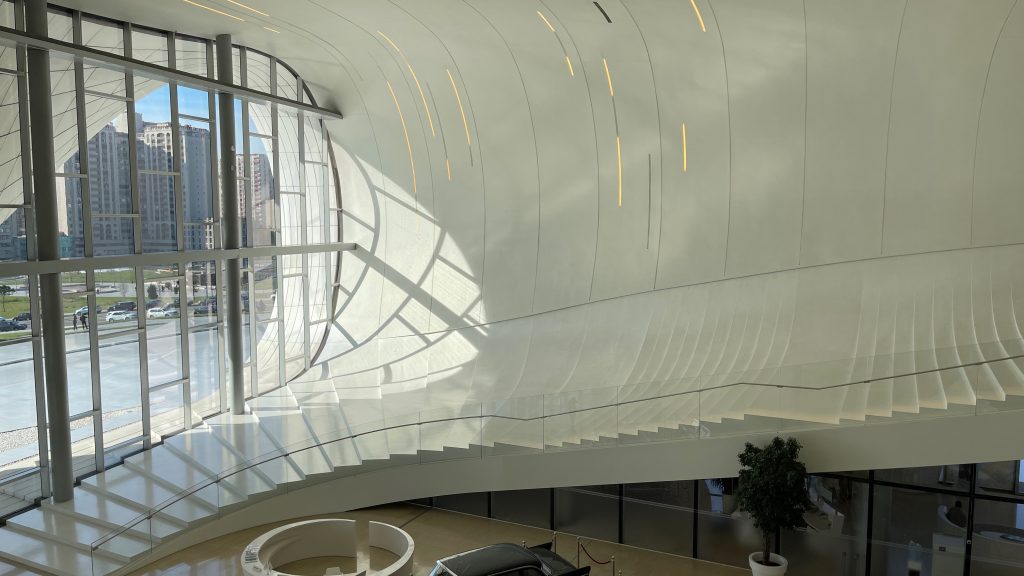
I did make a visit to the National Museum, which was designed by acclaimed architect Zaha Hadid. The stunning, curvaceous building had walls that became ceilings and floors and disoriented visitors passing through its vast halls. I found the exhibits interesting, including a look at the many architectural wonders of the country as well as history of music in the country when I was there. I passed through in a couple of hours, then returned to my hotel to pack and prepare for my flight.


I am grateful for the opportunity to have visited Baku. I truly enjoyed the many spectacular architectural marvels, and I appreciated the secularism of the otherwise-Islamic country. But I was left with a funny feeling about the country and its apparent unwillingness–not inability, but unwillingness–to take care of its most at-risk citizens that lack the ability to help care for themselves.
Ultimately, I still would highly recommend a visit to Baku. I think that it is important to see the uncomfortable side of things when traveling just as much as it is to have fun. Experiences like this are how we learn and grow and find ways to make improvements at home, by seeing problems like this abroad with an outsider’s perspective.
