


We left off on the story of our Icelandic adventure in a hotel on the south side of the island. We had completed a road trip of three-quarters of the rotation around Iceland’s famed Ring Road, and saw waterfalls, seals, whales, and lava fields. But it was the final three days of our trip that would become some of the most intense.

Extreme Hiking
The next morning, we were back in the car bright and early ready for a brand new leg of our trip. Today we had not one but two hikes on the agenda and we were excited to get out of the car. We began with a short and uneventful hike to a waterfall; it was a leisurely warm-up for the upcoming hikes, lasting for just a couple of miles.
From there, we drove towards Fjallabak Nature Reserve, a trip that measured about 90 km but which Google warned would take us the better part of two hours to drive towards. We soon found why there was such a disparity; first, the pavement ended and turned to gravel. The gravel road become more and more narrow until it was permanently one lane for both directions of traffic. Thankfully, traffic was light, though we did occasionally need to pull off and allow counter directional vehicles to pass us. Second, the road crossed a river.
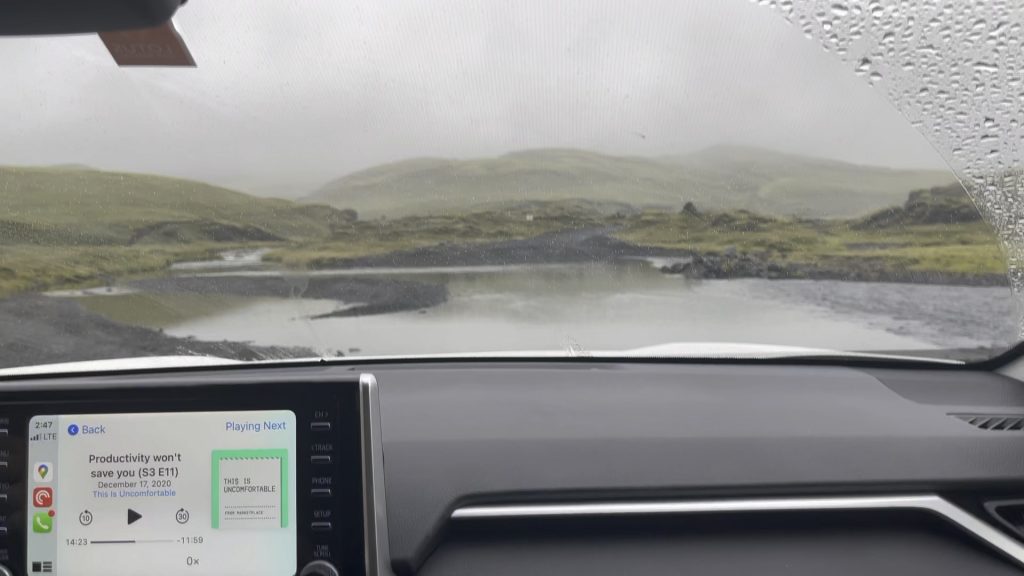
At first, we were confused. Were we missing a bridge in the distance? Did we miss a turn? Was the road simply flooded out? But, as two travelers going in the other direction told us as we stopped to ponder the situation, this was the intended route. We had to cross the river. “Whatever you do,” they warned us, “Do not stop. Keep driving when you’re in the water at all costs.” We rolled up our windows, gripped the steering wheel tightly, and started driving into the river. Our all-wheel-drive Rav4 kept spinning all four tires. For a moment, we seemed to slow down even as we pushed the accelerator even harder. We could feel the current fighting the vehicle outside, and then…we found traction and came out the other side of the river, alive, relieved, and thrilled. It was similar to the feeling of completing an enormous rollercoaster; you’re both happy it’s finished and, in hindsight, really appreciate the experience.
We crossed a few more rivers until we finally made it to the parking lot and campsite. The only vehicles here were larger all-wheel-drives like ours since clearly sedans couldn’t make it through these rivers. We had worked hard to get to this hike, so, we thought, it better be worth it!
Spoiler alert: We were not let down. This was one of the most beautiful hikes we did on our entire trip to Iceland. Almost immediately after setting off at the trailhead, we reached a clearing where the trail passed in front of a large clearing with a field in the foreground. Sheep dotted the field and grazed on the grass as we passed. In the background, a symphony of mountains framed in the field. The mountains were colored in wild gradients and stripes and the scene felt like we had entered a Bob Ross watercolor painting. We looked up at some “happy clouds” in the sky that Mr. Ross himself seemed to have added for good measure.

And then, we went up.
And up.
And up.
And up.

The trail became steeper and steeper and we looked up to see dots of people looking like ants crawling on the mountain peaks that we had yet to traverse. The path was narrow and we were exhausted and slightly frightened by the height, but we pressed on until we reached the peak.
The top was cold, with a bitter wind blowing that was made even worse by our sweat from both the hard work of climbing and the anxiety from being up so high. Still, we took a moment to appreciate the fantastic scene spread out below and all around us. The mountains we had scaled to get here now seemed like small rolling hills and we were those ants we had seen at the top just an hour before.

The trip down the other side of the mountain was arguably harder than the way up. While the way up was continuous and, at times quite steep, going down was a series of narrow switchbacks and, by nature, we were constantly looking ahead at all of the elevation we had yet to lose. One of our first steps on one of the first switchbacks caused a sort of mini rockslide as a few stones came lose and we nearly lost our footing at the top of the mountain. Now we had our eyes glued to the ground directly in front of us. After a terrifying hour back down the trail like this, we made it back to solid ground as the sun was beginning to get low in the sky.
We were exhausted and hungry and paid $40 USD for a couple of hot dogs and bowl of soup that someone was selling outside the back of a school bus at the campsite near the parking lot. After that, we still had to drive all the way back out through all the river crossings to get to our hotel for the evening. We went to sleep immediately, with alarms set for 6 am the next morning, for an even more extreme hike.
We knew this hike would be intense. It was sort of our grand finale event in Iceland. The length measured in at 16 miles. It wasn’t steep, but the first nine miles were a mostly constant uphill as we climbed about 3000 feet. This trail was a point-to-point trail which meant we had to arrange transpiration. Due to an even larger river crossing on the return trip from the end of the trail, only very tall vehicles are suitable to make the journey, so I scheduled a bus for us, but this set us on a deadline to complete the trail in time to not miss our bus.
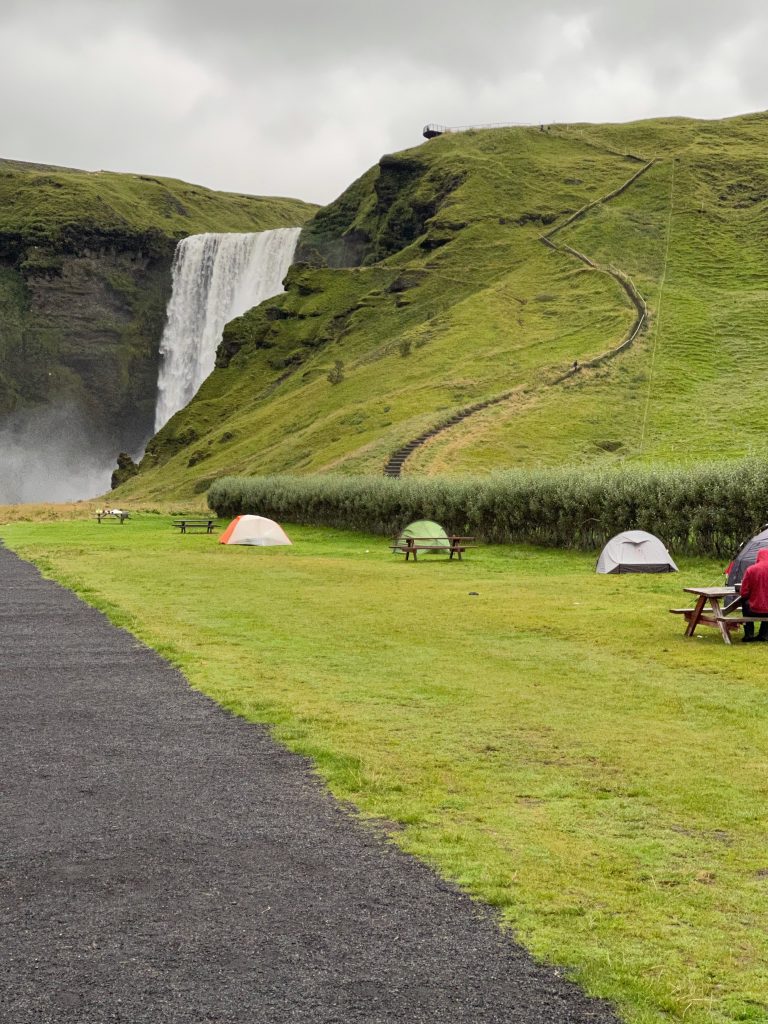
We began our hike at around 7:30 am in front of the magnificent Svartifoss Falls. We climbed a series of stairs to the top of Svartifoss, then the trail continued behind it and onwards. The morning at that moment had a crisp but inviting sense to it. We were excited to conquer what many people had called the best trail in all of Iceland. And we weren’t disappointed, at first.

The campsite at the magnificent Svartifoss Falls, with the 16 mile trailhead in the background. The ominous start of the 16 mile trail, Svartifoss, Iceland.
Over the first seven miles, we walked through the area affectionately known as Waterfall Way. By our count, we passed a total of 36 waterfalls. What began as excitement as we passed the next waterfall and the next quickly turned to monotony. Any one of these waterfalls by themselves could be an attraction but here, where they had 35 other competitors within a couple of miles, they became surprisingly less impressive. Still, this description should serve as a compliment to the sheer never-ending beauty of the scenery in this area.

And then, we crossed a tenuous bridge.
And everything changed.

On the other side of the bridge, the landscape went from lush and brightly saturated scenery to a brown moonscape. We were now in a former volcanic field, with the terrain formed by cooling and hardening lava. As we walked, the wind picked up and the temperature dropped. Light rain began to fall. We became increasingly cold and started to wonder if it would be wise to continue.

After a couple of miles like this, we reached a small shanty where we stepped inside to have lunch. It was warm and we stripped off our clothing and enjoyed being out of the wind and elements while we ate our packed PB&Js. There was a ranger there and we asked about the weather continuing the trail. She informed us that the wind may pick up a bit more, but it shouldn’t be anything too crazy or dangerous. After a time, we bid farewell and continued on our way with several other travelers who had arrived at the shanty during our stay.
Moments after leaving the shelter, the wind indeed picked up, and the light rain turned to a heavy sleet and, for a time, to snow. We crossed a glacier, still frozen and climbed its icy wall. We were hiking in a blizzard. It was cold, wet, and icy. There was nothing to grab to hold on and stabilize ourselves except for the ice itself. We looked up only to search for the next cairn and confirm we were still on the correct path. We questioned ourselves; should we continue or should we turn back? But if we did turn back, we reasoned, would the weather be any better in the other direction? Plus, now, we were closer to the end of the trail than the beginning. And so we pressed onwards.

Eventually we made it across the glacier and the icy terrain turned back to a rocky ground, which provided much better traction. The precipitation let up, but the wind did not. In fact, it got windier. We found ourselves in one of Iceland’s infamous—and unpredictable—wind storms. Based on our research, we estimated the wind gusts to be between 40 and 50 mph and as the trail became one of Iceland’s many to travel along a cliff face, we at times were nervous a strong gust would blow us right over and tumble down the mountain. At this point, the trail was downright dangerous.
As we continued, we encountered a rope hold, but the second stake was out of the ground, leaving it unstable and loose looking. It was an ominous sign for this small hold that was clearly meant to keep us secure as we scaled a cliff face and continued our drop back down all 3,000 feet we had climbed in Waterfall Way. Thankfully, only the second stake was out and the rest of this rope was actually quite secure and in good condition. After the rope walk, the trail became much wider and less steep. As the trail conditions improved, the sun came out and warmed us. The weather improved at the same time the trail became less extreme.
This was not a pleasant trail. Even looking back on the experience, it was not enjoyable. We couldn’t tell if the weather was extreme up in the mountains and cleared as we descended below it, or if the weather happened to clear at that moment in our descent. Either way, most of this trail was downright miserable after the bridge that marked the end of Waterfall Way. We completed the 16 mile challenge, but it was not the glorious grand finale we were hoping for.
The bus was punctual and when we arrived back at the hotel that evening, I decompressed in the hot tubs beckoning from outside.
The next day was our last full day in Iceland. We visited Iceland’s famous Golden Circle where we saw one more waterfall, Gullfoss Falls, which was truly beautiful. We also visited Geyser. This was the first geyser ever discovered and all other geysers in the world are so named after this one, whose name is simply Geyser. Finally, we visited Kerid Crater and walked both the upper and lower rims of the spectacularly blue water in the crater.

Gullfoss Falls 
Geysir 
Kerid Crater
And then, the end of final attraction of the trip: snorkeling at Thingvellir National Park. The water was cold and nearly icy, just above freezing. This temperature is too cold to support abundant life. From time to time, snorkelers will spot trout or other hardy fish, but the most frequent signs of life here are simple algae. So why do people snorkel here? Because the water is among the clearest in the world and it’s possible to see through it for miles unending. In fact, it’s possible to remove your snorkel and drink up; it’s that clean and safe and good tasting. It’s also popular to snorkel because it’s possible to touch two tectonic plates at once; as the European and North American plates diverge, they create the rift into which we snorkeled and at one particular location, it is possible to touch both continents.

We wore wet suits including booties over our feet and gloves over our hands. In fact, the only parts of our bodies that weren’t covered with this protection was our face, over which we put our mask. Our instructor told us that it would feel cold at first but after a couple of minutes we would forget all about it. He neglected to mention that the reason we wouldn’t feel cold anymore was because our faces would simply go numb. Part of my wet suit had torn and water leaked into my left wrist and infiltrated my hand. My toes also felt icy cold. In short, it was absolutely freezing. I tried to keep moving to push those thoughts out of my head. I admired the scenery and took numerous dives—after all, we were on a free-diving tour and had extra weights to help us get deeper—but ultimately I was still enormously happy to get out of the icy water and enjoy a glass of hot chocolate.

And with that, our Icelandic trip was coming to a close. All that was left now was a short drive back to our airport hotel for the evening. We just had to fill up the rental car with gas in preparation for returning it.
Still cold and somewhat groggy, I grabbed the gas pump and thought about how it felt slightly ghetto as it didn’t quite fit right into the hole of the car’s tank. As we drove away from the gas station, almost immediately the car started to seize up. We were able to coast down a hill, but as we pulled into our hotel parking lot the car’s display told us the engine had a critical failure and we should pull over immediately. We managed to coast into the hotel parking lot, both relieved and worried at the same time. As we were talking, I realized that the reason the gas pump didn’t quite fit into the car was because I had put diesel into this unleaded vehicle. It turns out this is not unusual for American tourists to do in Iceland since the pump colors are reversed relative to the states (in the US, unleaded is black and diesel is green, but it’s the other way around in Iceland). It’s easy for the unconscious mind to mistakenly grab the color pump you’ve grown up, and that’s exactly what happened here. I learned that putting unleaded fuel in a diesel engine will almost certainly total the car, but fortunately the other way around—putting diesel in an unleaded—is what happened to us and is less fatal. It can be resolved by simply completely draining the tank and then putting in the correct fuel. The rental agency informed us that a couple hundred dollars should resolve the problem.
After this anxiety-inducing end to the trip, it was a relief to clear European immigration and settle into my seat on the 7 hour plane ride back to the United States. At least my gas mistake didn’t land me in Icelandic prison, I thought as I drifted into half-slumber in the tight economy seat somewhere over the Atlantic Ocean.
