

I exited the metro station and emerged into the bright and hot daylight of a July Saturday in Madrid. As I looked around and got my bearings, I noticed that I was standing in front of the famous Puerta de Alcalá, one of Madrid’s largest and most famous city gates. It was surrounded by a massive roundabout, filled with traffic hurriedly pushing through en route to destinations all over the city.
The wide sidewalks around the roundabout were also bustling. People were milling about while cafes were busy serving food and drink. It was clear that I was in a tourist district as I noticed many people with selfie sticks extended and café menus written in English with inflated prices.
I was hungry and Googled one café at random; it had low reviews for the quality of the food and I decided to head to my hotel and drop off my things first, and then take the time to find food I’d be more excited about.
Squares of Central Madrid
I would be staying just across the street from Retiro Park, one of the largest city parks in Madrid, at the Autograph Collection Palacio de Retiro. The biggest challenge in getting to the hotel was finding a way to cross the busy boulevard that runs in front of the park. Eventually I made it into the lobby and was greeted by hotel reception. My room wasn’t ready, but I could drop my bags, they told me, and explore the city while I waited. They’d call when my room was cleaned.
Feeling ravenous at this point, I made it my priority to find lunch. The small café I discovered was perfect, serving a very fresh and filling sandwich. I followed it up with a fruit smoothie. Finally feeling satiated and able to concentrate, I began to wander around the city.
It’s at this point that I need to interrupt the story to explain that wandering is one of my favorite things to do as I explore an unfamiliar city. Sometimes I’ll pick a destination that’s far away in order to give me a general direction to walk in, but in this case I walked completely aimlessly, craning my neck in all directions to take in the sights.


The hotel called not long after I finished lunch, but I felt fresh and excited, ready to explore, so I decided against returning at that moment. Instead I followed the narrow and winding streets endlessly, making random turns and walking up and down through Madrid’s surprisingly hilly terrain. As I walked, I noticed locals out strolling, eating, or running errands. I even walked through a Spanish grocery store and admired its compactness and efficiency compared to American supermarkets.
Eventually I stumbled upon the Royal Palace, which was adjacent to one of the city’s largest cathedrals (Catedral de Santa Maria la Real de la Almudena). This was an area that I wanted to check out more intentionally.
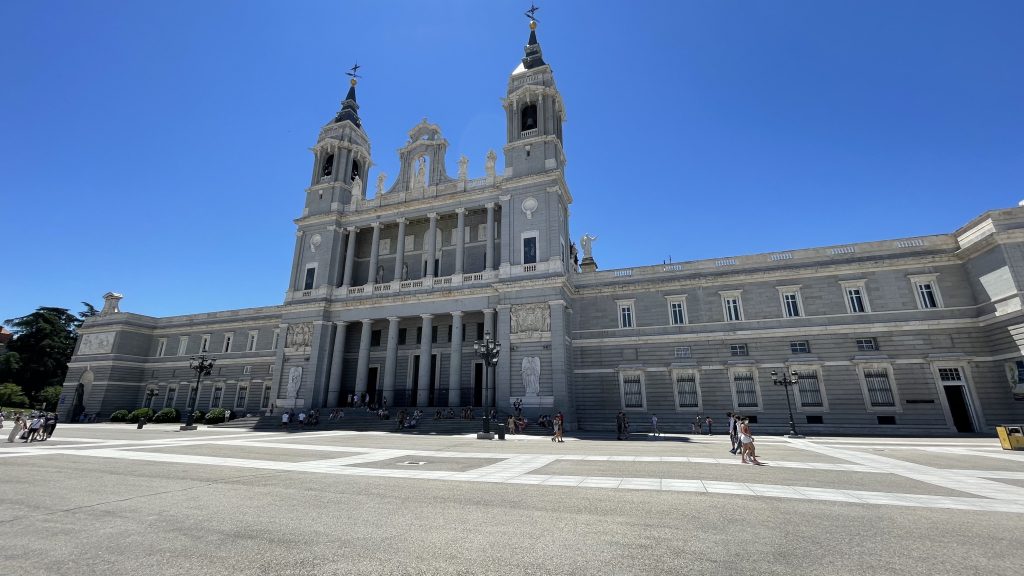
Anyone who’s been to Europe knows that impressive cathedrals and basilicas are table stakes here and even the nerdiest of architecture nerds can reach their upper limit on appreciating these grand European churches on account of just how many they are; but the unique part of this cathedral is that it features a second, entirely underground, nave called the crypt (Cripta de la Almudena). The crypt is open for touristic visits and admission is free, with just a suggested donation of a euro or two. As I walked through, I marveled at how this spectacular scene was only the second best in this grand old cathedral.

When I returned above ground, I walked around the building and actually struggled for a few moments to find the entrance to the main nave. Ironically, the crypt entrance was much easier to locate. The fairly obvious doors on the large plaza between the cathedral and the palace were not an entrance. I was excited to go inside because I had been told that the towers allowed visitors and offered views among the best in the city. While I did eventually find the entrance, and while the beautiful stained glass towering above me was certainly impressive, the spires were closed, and I left feeling somewhat disappointed nonetheless. The crypt was the most interesting piece here to me.
The palace tours were expensive and had a long wait, so with several miles of walking already under my feet, I decided to forgo this attraction and began wandering slowly, but generally, in the direction back to my hotel.
For this return walk, I intentionally took a very different route and, this time, walked through some of Madrid’s grandest old squares. I stumbled first upon the most important one of them all, Plaza Mayor. It reminded me a bit of Prague’s main plaza. It featured a very literal square, enclosed by an old four-story building on all sides. The building features several large arched entranceways that allow pedestrians to cross underneath it without going inside in order to reach the open-air square. Today, the first floor includes space for shops and restaurants while the upper stories are apartments. On the square, tourists and locals alike meandered to their destinations or sat at tables under umbrellas enjoying their drinks and canapes.

As I exited the square, I realized I was becoming increasingly tired and thirsty. I wanted to sit with a cold glass of water, but the restaurants in the square seemed like fancy sit-down places, which wasn’t quite what I was looking for. As I continued to wander, I approached the Opera House Square. It was here that I found a delicious lemonade and sat to people watch for a few moments while I drank it and recovered.
Eventually, I made it back to my hotel, where I enjoyed a nap and revitalizing shower before getting ready to head out again for an evening on the town. Spaniards are notorious for their after-dark parties, and I was excited to check out the action.
Heading out after dark, I had a more specific destination loaded into my GPS. I was hungry and excited to visit the Mercado Antón Martín, a large food hall near Plaza Mayor. One of the challenges of visiting Spain as a solo foodie traveler is that Spain’s national dish of tapas are typically intended to be shared. This can make it challenging to try lots of foods and awkward to do so in fancier restaurants alone. The food hall solves these problems as it gives an opportunity to try multiple small dishes in a casual environment where it’s irrelevant that I’m there alone.
I had several excellent dishes including a sort of large cheese curd that was also stuffed with meat, a Chinese-inspired bao, and a Spanish omelet. I was quite full, but I couldn’t possibly end my evening without dessert!


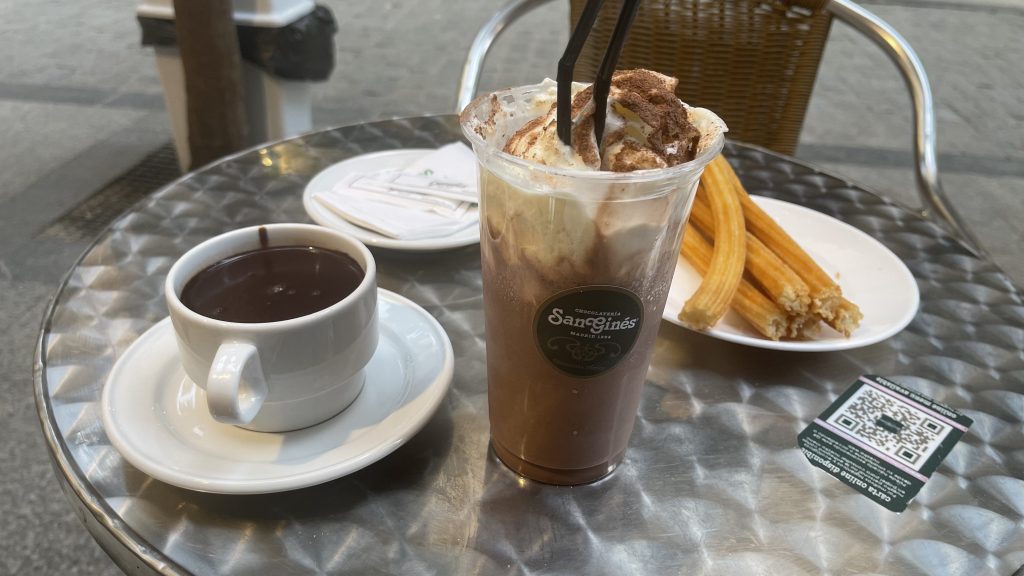
At the Plaza del Sol, my final Madridian square for the day, I found Chocolateria San Gines, where I accidentally ordered two desserts, churros and a milkshake. I couldn’t let them go to waste, so I made sure to finish both!
I people watched on the Plaza del Sol for a few minutes, and, as I began strolling back to the hotel, I came across a street performance group putting on an impressive show. It lasted just a couple of moments before the cops arrived to break it up. It turns out street performances have been illegal in Madrid without a permit for the last decade. In order to receive a permit, a group needs to audition to the city council and be approved.
Sundays in Madrid
Sundays in Madrid have a very specific laid-back vibe. A common Sunday agenda for a local looks like visiting the massive street market in the morning and having a picnic in one of the city parks, perhaps combined with a siesta, in the afternoon. I set out to visit the El Rastro market after a hearty breakfast at the hotel.
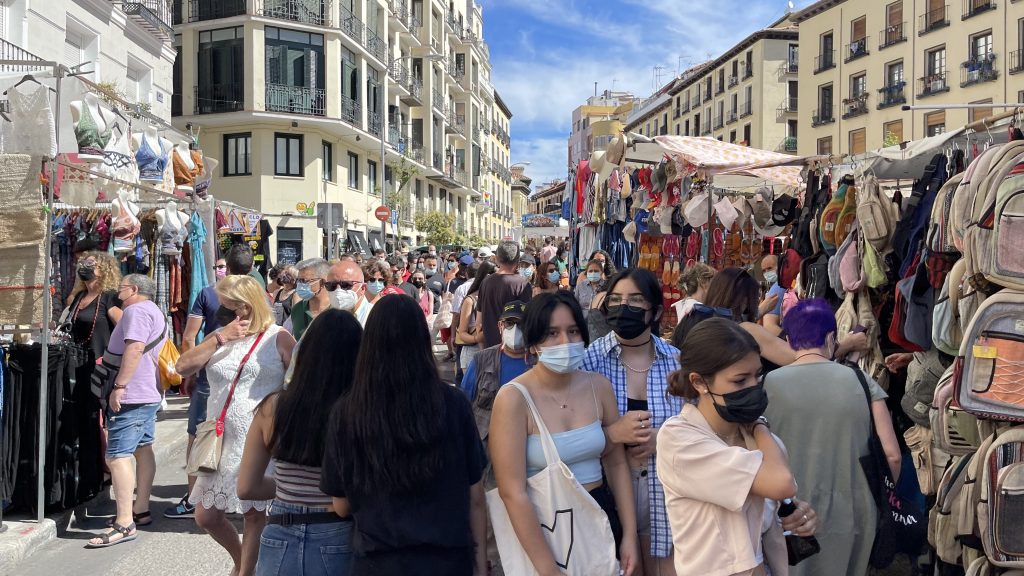
Once I made it to the market, my first thought was that this place was packed! I walked past the stalls; many were selling clothes and homemade décor. I’ve visited many markets before—one in Kuala Lumpur, Malaysia, specifically comes to mind as one of my favorites—and I love seeing locals mingle and trying unique foods. There were no food booths here and too many people to really appreciate the scene. And with the pandemic so recent in memory, I still didn’t feel comfortable being in such cramped quarters with that many people. I marveled mostly at how long the market went on for—it felt like it lasted a mile! But when I reached the end, I continued on my way unceremoniously.
At this point in the trip, I had to run an errand. The US was continuing to mandate a negative covid test for entry, even for citizens returning home. I made an appointment at a testing facility on the north side of the city, giving me an opportunity to explore the hip Chamberí neighborhood on my way there. Chamberí is a less dense and more residential district than the commercial and tourist-powered Centro district in which I had spent most of my time so far. I enjoyed seeing more typical—if gentrified—neighborhoods filled with kids playing ball on quiet streets and adults enjoying a drink on a restaurant patio in the afternoon sun.
After my covid test, I headed for the Prado, a major museum in Madrid. Although less famous than its peer the Louvre, the Prado is every bit as much of an important art institution. Madrid has two other world-class art museums, which I didn’t make it to on this trip. I’m not a huge fan of art, but I was thoroughly impressed with the size of the museum and spent several hours wandering through it and examining the many marvelous paintings.

Afterwards, I strolled through the Madrid Botanical Gardens and, of course, enjoyed some ice cream. As I walked back to my hotel, I decided to peruse Retiro Park, just across the street, before calling it a day. Retiro Park felt very much like New York City’s Central Park, featuring a large expanse of green space nestled between busy city blocks. Inside this quiet reprieve from the city, people laid out on the grass reading books and talking. Canoers paddled around a large central lake and kids played catch or tag with their friends. Finally, I returned to my hotel, exhausted, after walking double digits of miles for the second day in a row.
History in Toledo
My third day in Madrid was a Monday. Before even leaving the hotel, it felt like this day had different vibes. It was a work day, no more resting here! As I strolled out of my hotel, I noticed that people seemed to be walking more purposefully towards a destination than they were over the weekend; they were certainly in more of a rush, out earlier in the morning, and dressed more nicely. There was now an air of seriousness rather than leisure and relaxation.
I wanted to go on a day trip on this day to the city of Toledo. Toledo is located a short 45-minute train ride away from Madrid. I left my hotel with directions in hand, bound for the train station, with just as much haste as every other commuter in my vicinity. After all, I only had a half hour until the train departed.
But for some reason, Google Maps was showing me only routes to the train station that included buses. I knew a metro line ran from my hotel to the main long-distance train station, so I looked it up in other apps, but they also were now telling me to take the bus. Even standing in the metro station, the apps didn’t seem to think that Madrid’s metro existed at all. (I’m not sure what happened, but the metro data feed wasn’t restored for the rest of my trip; the apps continued recommending bus only despite very real and more efficient metro options available.)
As it turned out, without directions to rely on, I got on the correct metro line, but in the wrong direction. Realizing the error of my ways, I tried to change platforms, but the train in the other direction had just departed. I was now in an outright sprint back to the street level to catch a bus, fearing I would miss my train to Toledo.
I made it to the train station with just five minutes to spare before my train departed. But I was confused on where and how to buy a ticket and, by the time I figured it out, I had missed my train after all. The next one left an hour later.
The wait was a blessing in disguise. After I collected myself and the sweat ran off my face, I was able to appreciate the stunningly beautiful Madrid train hall. The open atrium featured a large indoor botanical garden and, with this gift of time, I had the chance to explore it.

After a few minutes passed, I noticed that the next trip to Toledo, my train, showed up on the departure monitors, and I wandered through security and to the active platform. I found a seat on board and the train departed promptly on time.
When I arrived in Toledo, my first reaction was one of awe at a train station that felt like an old church. It was small, with just two platforms and a center pedestrian aisle between them, but there was a beautiful stained glass window in the ceiling of the terminal. There were also hordes of people leaving my train, and it took me several moments to thread my way through to the outside, but I eventually made it around the corner and down several blocks to the entrance of the great city of Toledo, which is an ancient castle city surrounded by a moat.

I decided to begin by walking around the city rather than through it, following the ancient route of Don Quijote. I circled the city, enjoying fantastic views until I made it 180 degrees to the opposite landing and crossed the moat to begin exploring.

Inside, the city felt like Assassin’s Creed came to life. Everywhere I looked were old but well maintained buildings, vendors selling their wares, and props like wagons of hay that seemed tailor-made for this city.
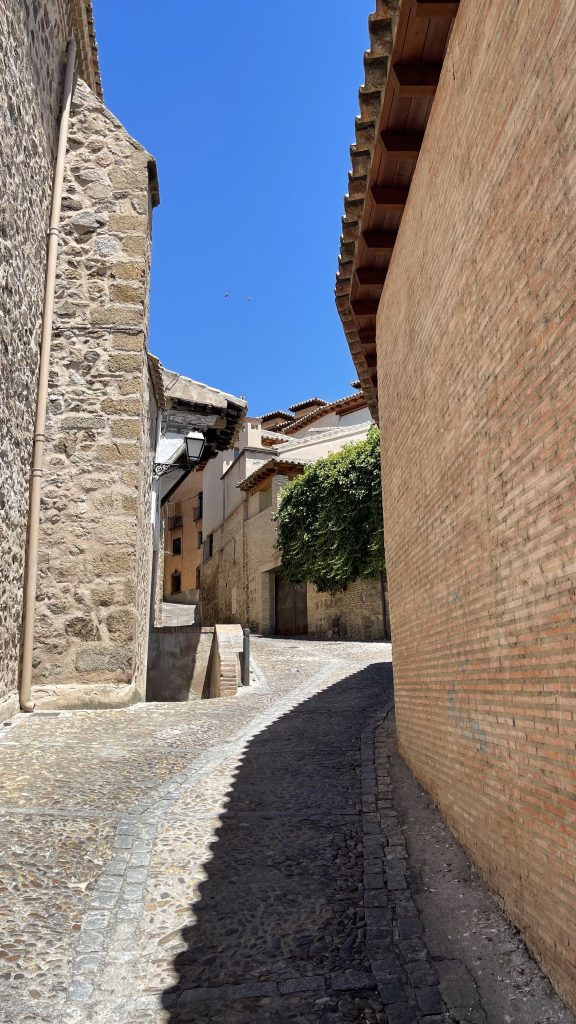

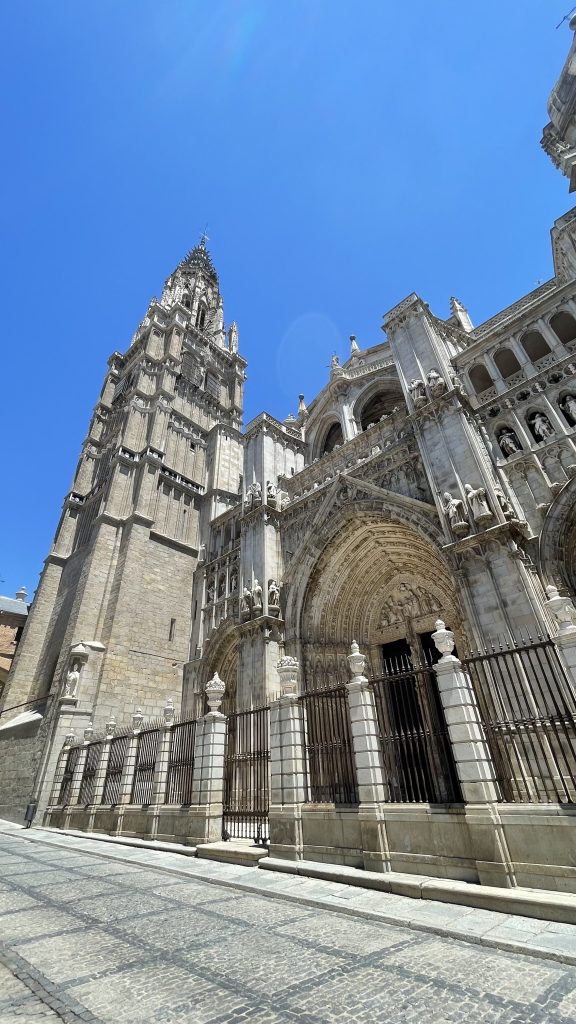
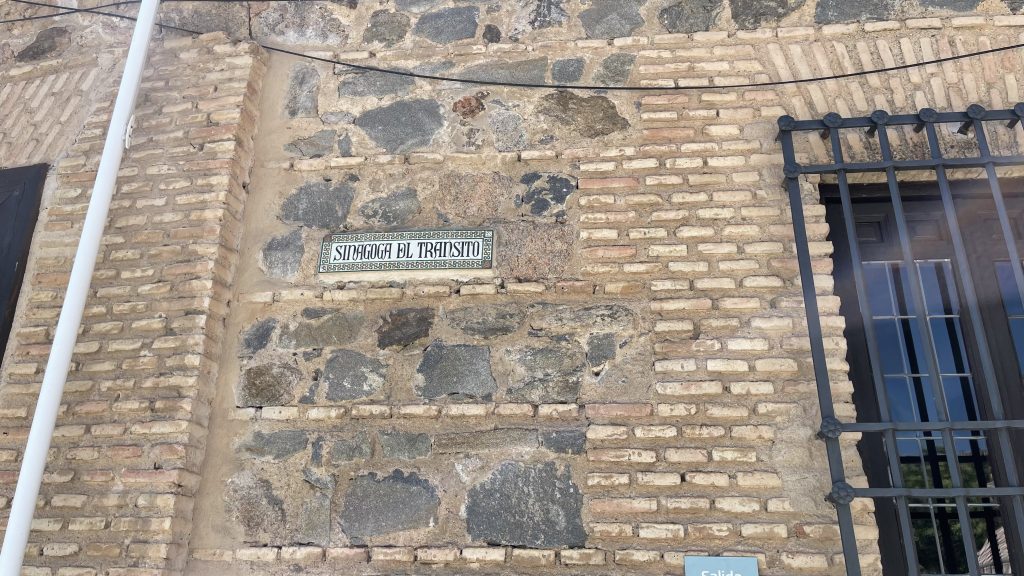
Toledo has a fascinating history; for centuries Christians, Jews, and Muslims lived here side-by-side and in peace. My mission inside the walls of the moated city was to see the cathedral, synagogue, and mosque, dating from that period, as well as the castle. The cathedral was by far the grandest of the four buildings, towering above everything around it at the very center of the city. All that remained of the mosque was a small, fenced-off building that I might not have recognized at all if I weren’t looking for it. The synagogue was also unremarkable, with a trailer parked in front of it while it was undergoing restoration. The castle was physically imposing but not exactly beautiful. Although these religions coexisted peacefully here for a long time, during the Crusades, Christianity won out and the importance of the buildings of Judaism and Islam was reduced.


By the time I made it back to the train and to my hotel, I was absolutely drained. I had walked 15 very intense miles in the blistering heat as I explored Toledo, and I had no trouble falling asleep.
The next day, I got an early start. It was my last day in Spain, but I had a few hours before I needed to leave for the airport. I explored one more area I hadn’t gotten to in Madrid yet, the Templo de Debod. This ancient Egyptian temple was dismantled and moved to Madrid and is now open to be explored in the center of the city. I also enjoyed wandering around the surrounding park area.

Next, I headed back to the airport. I took the metro, again without any help from Google, but this time I got on the right train in the right direction. I had learned Madrid’s transit system just in time to leave the city.